ICSI Training for Embryologists: What Hands-on Micromanipulation Training Should Cover
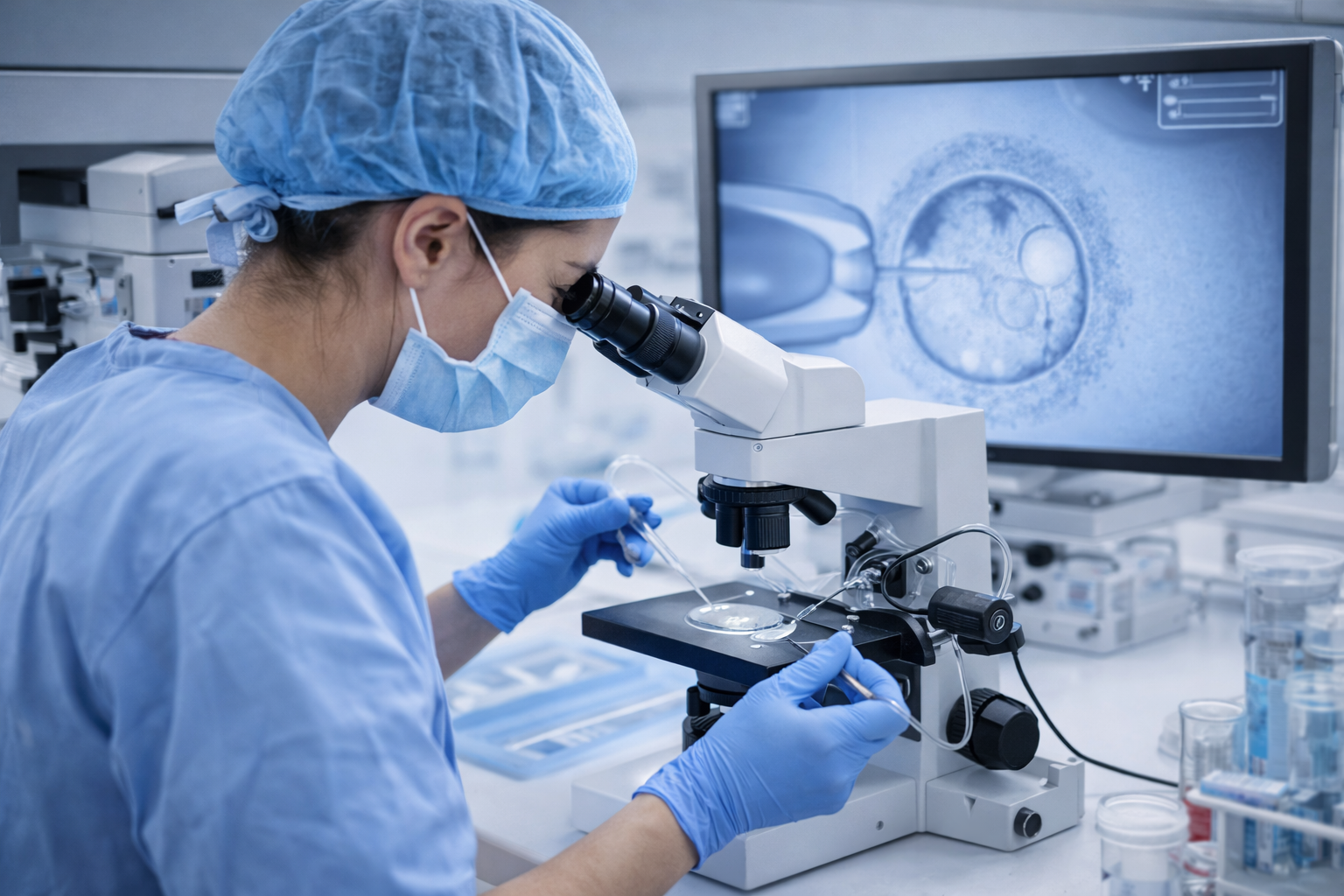
Intracytoplasmic sperm injection (ICSI) - first reported by Palermo and colleagues in 1992 - involves injecting a single sperm directly into an oocyte. It is now one of the most frequently performed procedures in IVF laboratories. It is also one of the most technically demanding, and the quality of an embryologist's ICSI technique directly affects outcomes. That is why structured, hands-on training matters.
Prerequisites before ICSI training
Trainees get the most from ICSI training once they are comfortable with:
- Sterile laboratory technique and handling culture media
- Oocyte identification and denudation
- Semen preparation methods
- Basic embryo culture
What a good ICSI programme should cover
1. Understanding the micromanipulator
Trainees should understand every part of the system: the inverted microscope, heated stage, micromanipulators, injectors (air or oil based), and how holding and injection pipettes are mounted and aligned. Most early difficulties come from poor set-up rather than poor technique.
2. Dish preparation
Correct preparation of ICSI dishes - PVP droplets for sperm, media droplets for oocytes, overlaid with oil - and proper labelling and witnessing are fundamental.
3. Sperm selection and immobilisation
- Selecting morphologically normal, motile sperm at high magnification
- Immobilising the sperm by compressing the tail with the injection pipette
- Aspirating the sperm tail-first into the pipette
4. Oocyte assessment and positioning
- Confirming maturity: only metaphase II oocytes, with a visible first polar body, are injected
- Positioning the polar body away from the injection path (commonly at 6 or 12 o'clock) to avoid the spindle region
- Holding the oocyte securely without excessive pressure
5. The injection
- Penetrating the zona pellucida and oolemma cleanly
- Confirming membrane breakage, often by gentle aspiration of cytoplasm
- Depositing the sperm with minimal medium and withdrawing smoothly
6. Post-injection handling
Returning oocytes promptly to culture, recording details, and later checking for fertilisation (two pronuclei) at the correct time.
Training should be progressive
The safest learning path moves through stages:
- Practising pipette handling and set-up
- Working on practice material, such as animal oocytes or donated discarded material where permitted
- Supervised clinical ICSI, with a senior embryologist reviewing every step
- Independent practice with ongoing audit of fertilisation and degeneration rates
Monitoring personal outcomes - such as fertilisation and oocyte degeneration rates - is how trainees and laboratories know when competence has been reached.
Related advanced techniques
Comprehensive programmes often also introduce:
- Laser-assisted hatching - creating an opening or thinning the zona pellucida using a laser
- Embryo biopsy for preimplantation genetic testing, usually trophectoderm biopsy at the blastocyst stage
- Approaches to sperm selection for difficult male-factor cases
Common challenges for trainees
- Oocyte lysis after injection, often related to pipette angle, speed or excessive aspiration
- Difficulty immobilising very motile sperm
- Poor pipette alignment causing the oocyte to move during injection
Each of these improves with feedback from an experienced mentor watching the procedure on screen.
Train with ReproNest
Our Masterclass in Micromanipulation & Advanced ICSI / Laser Assisted Hatching in Delhi NCR builds ICSI skill step by step on the micromanipulator, with close mentor supervision. Trainees new to the IVF laboratory may want to begin with our Clinical Embryology & IVF Lab Training. Contact our team to plan your training.
About the Author
ReproNest Academic Team
Medical Expert
Specialist in Reproductive Sciences with years of clinical and educational experience.