The Role of Hysteroscopy in Infertility Work-up and Recurrent Implantation Failure
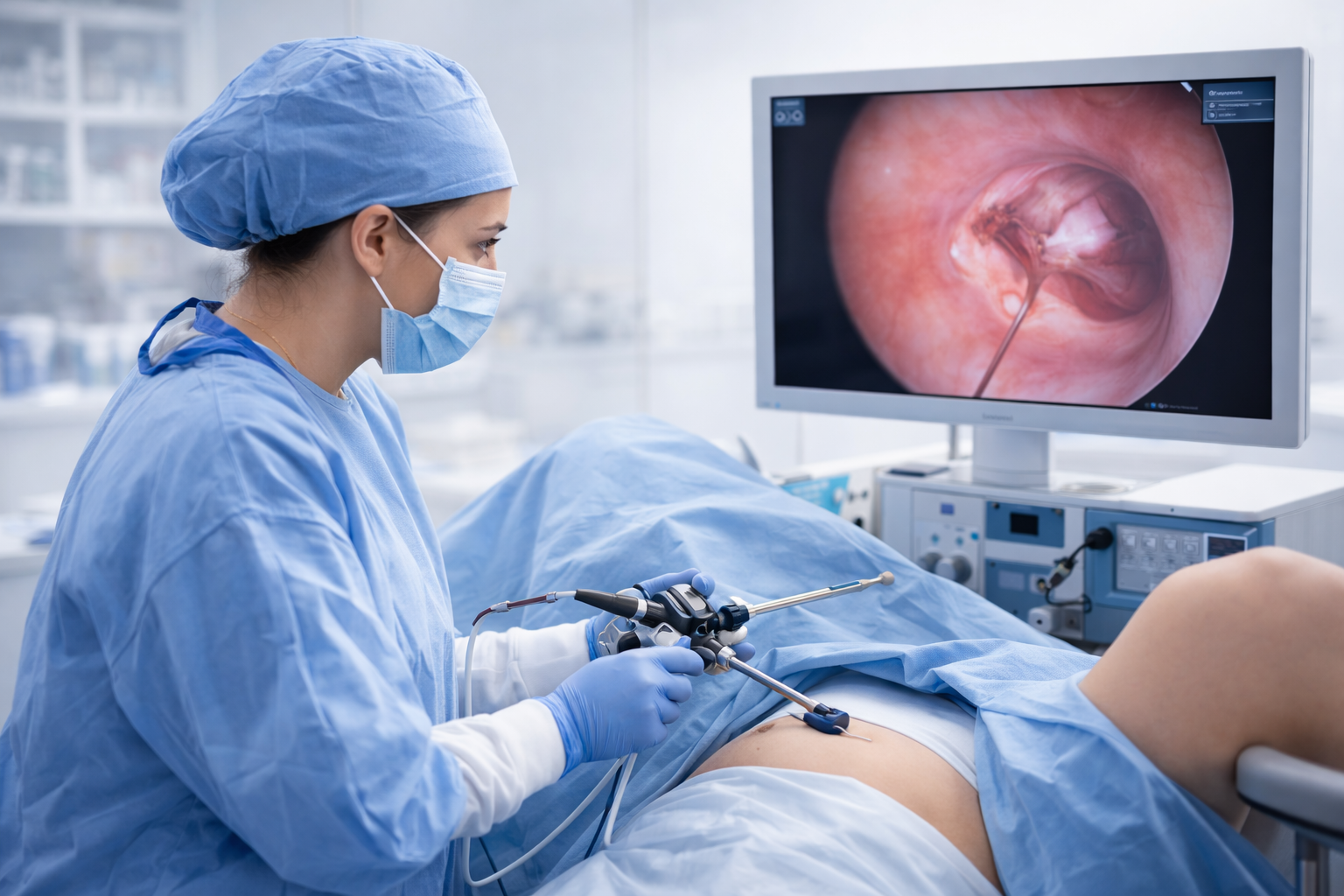
A receptive uterine cavity is essential for implantation. Hysteroscopy is the most direct way to examine and treat the cavity, so it has a natural place in fertility care. But when exactly should it be used? This article looks at uterine factors in infertility and how hysteroscopy fits into the work-up.
Uterine factors that can affect fertility
Several intrauterine conditions may interfere with implantation or pregnancy:
- Endometrial polyps - common and often found incidentally
- Submucous fibroids - fibroids distorting the cavity are associated with lower implantation rates
- Uterine septum - a congenital anomaly associated with pregnancy loss
- Intrauterine adhesions - often following curettage or infection
- Chronic endometritis - an inflammatory condition sometimes diagnosed with hysteroscopy and endometrial biopsy
- Retained products or foreign bodies
How the cavity is first assessed
Initial screening often uses transvaginal ultrasound, ideally 3D, and saline infusion sonography. These are less invasive and can identify many abnormalities. Hysteroscopy offers direct visualisation and, crucially, the ability to treat many findings in the same procedure ("see and treat").
When is hysteroscopy commonly considered?
- An abnormality is suspected on ultrasound or sonohysterography
- Abnormal uterine bleeding
- A history of intrauterine surgery or infection suggesting adhesions
- Recurrent pregnancy loss, to assess for septum or other anomalies
- Recurrent implantation failure (RIF) after IVF, as part of a broader evaluation
What does the evidence say about routine hysteroscopy before IVF?
This is an important point for clinicians. Large randomised trials have not shown that routine hysteroscopy before a first IVF cycle - in women with a normal ultrasound - improves live birth rates. Hysteroscopy is therefore best used selectively: when there is a clinical or imaging indication, or in women with recurrent implantation failure where other causes are also being assessed.
Clinicians should explain this honestly to couples. Hysteroscopy is valuable when there is something to find and treat; it is not a guarantee of success on its own.
Hysteroscopy in recurrent implantation failure
RIF has many possible causes: embryo factors (including chromosomal abnormalities), uterine factors, and other maternal factors. A structured RIF evaluation may include:
- Review of embryo quality and laboratory factors
- Assessment of the uterine cavity, often including hysteroscopy
- Evaluation of conditions such as hydrosalpinx, thyroid disease and other relevant maternal factors
When hysteroscopy does find pathology - such as polyps, adhesions or a septum - treating it addresses one potentially modifiable factor.
Practical points for clinicians
- Timing - performing hysteroscopy in the early proliferative phase usually gives the clearest view
- Office or theatre - many diagnostic and minor operative procedures can be done in the office with small scopes
- Communication - integrate findings into the overall fertility plan and timing of treatment
Build your hysteroscopy skills
Using hysteroscopy well needs both skill and judgement. ReproNest's Diagnostic & Operative Hysteroscopy Surgical Training covers technique, safety and case selection. See also our guide on hysteroscopy training for gynaecologists, or contact our admissions team.
About the Author
ReproNest Academic Team
Medical Expert
Specialist in Reproductive Sciences with years of clinical and educational experience.